NHTSA ID Number: 10110447
Manufacturer Communication Number: SMB120
Summary
Service Manual Bulletin – Disc Brake System Inspection.
1 Affected Product
Vehicle
SMB-120
ISSUE DATE: Dec 10 2012
Disc Brake System Inspection
PM – PREVENTIVE MAINTENANCE
The preventive maintenance information for the disc brake system may not have been available at time of publication of your New Flyer Service Manual. This bulletin provides preventive maintenance information for
the disc brake pads, calipers, and brake chambers used on your New Flyer vehicle.
This information supersedes any prior information on this subject already provided in your New Flyer Manuals. Make this Service Bulletin available to service personnel to inform them of changed information.
SEOCONTENT-STARTSMB-120 1 of 6
SERVICE MANUAL BULLETIN
This Service Manual Bulletin is prepared by the Publications Department of New Flyer Industries
Canada ULC. Refer to details below.
The New Flyer vehicles described in this manual may be protected by one or more
patents and design applications or registrations in the United States and Canada,
and in other countries. Refer to “Vehicle Patent Information” in this manual.
Copyright © 2012 New Flyer Industries Canada ULC
ISSUE DATE: Dec 10 2012
SMB-120
APPLICABILITY
VEHICLE LENGTH 30ft. 35ft. 40ft. 60ft. ALL
VEHICLE TYPE High Floor Low Floor Invero Xcelsior ALL
FUEL TYPE
Diesel Electric CNG LNG
ALL
Diesel/Electric Gas/Electric Fuel Cell
SUBJECT Disc Brake System Inspection
SECTION TITLE PM – PREVENTIVE MAINTENANCE
DETAILS The preventive maintenance information for the disc brake system may
not have been available at time of publication of your New Flyer Service
Manual. This bulletin provides preventive maintenance information for
the disc brake pads, calipers, and brake chambers used on your New
Flyer vehicle.
This information supersedes any prior information on this subject
already provided in your New Flyer Manuals. Make this Service Bulletin
available to service personnel to inform them of changed information.
2 of 6 SMB-120
SERVICE MANUAL BULLETIN
SMB-120
The New Flyer vehicles described in this manual may be protected by one or more
patents and design applications or registrations in the United States and Canada,
and in other countries. Refer to “Vehicle Patent Information” in this manual.
Copyright © 2012 New Flyer Industries Canada ULC
1. Disc Brake System Inspection
1.1. Purpose
This bulletin is issued to ensure that all
users are aware of the preventive maintenance
intervals and procedures for the
disc brake system.
1.2. 6,000 Miles (9,600 km) Preventive
Maintenance
1.2.1. Disc Brake Pad Wear Inspection
Visually check brake pad wear every 6,000
miles (9,600 km) or every 3 months, whichever
occurs first.
☞NOTE:
Brake pad wear can be assessed visually
without removing the brake pads using the
following procedure.
1. Locate the lower caliper guide pin.
2. Inspect the amount of guide pin bushing
showing on the caliper lower guide pin. A
fully extended bushing indicates a new
brake pad condition. A retracted bushing
with less than 1 mm showing indicates a
worn brake pad condition. See “Fig. 1:
Brake Pad Wear Inspection” on page 2.
3. If a worn condition is indicated, remove the
brake pads and measure actual thickness
of friction material. Refer to Section 1 or 2
of your New Flyer Service Manual for
brake pad removal procedure. Replace
brake pads if measured thickness is 0.118″
(3.0 mm) or less.
4. If brake pad thickness is within limits,
inspect condition of friction surface. Minor
material breakout at the edges is permitted
but major material breakout is unacceptable.
Replace brake pads as necessary.
☞NOTE:
Replace all brake pads on same axle. DO
NOT replace one side only.
Fig. 1: Brake Pad Wear Inspection
????????????????????????
????????????????????????????????
????????????????????????????????????
????????????????????????????????????
????????????????????????????????
????????????????????????????????????????????????????????????????????????????????????????????
????????????????????????????????????????????????????????????????????????????????????????????????
????????????????????????????????????
????????????????????????????????????
????
????
s122252a.svg
SMB-120 3 of 6
SERVICE MANUAL BULLETIN
SMB-120
The New Flyer vehicles described in this manual may be protected by one or more
patents and design applications or registrations in the United States and Canada,
and in other countries. Refer to “Vehicle Patent Information” in this manual.
Copyright © 2012 New Flyer Industries Canada ULC
1.3. 36,000 Miles (58,000 km) Preventive
Maintenance
1.3.1. Disc Brake Caliper Inspection
Perform a disc brake caliper inspection
every 36,000 miles (58,000 km) or every
year, whichever occurs first. A more frequent
inspection may be necessary
depending on the operating conditions.
Perform the following inspections:
❒ Inspect the six brake caliper mounting
bolts that attach the brake caliper to the
axle to ensure the bolts are tight. Refer to
Section 1 and 2 of this manual for mounting
bolt torque specifications.
❒ Inspect the eight M12 and two M10 Torx
bolts on the caliper housing to ensure they
are not loose or broken.
❒ Caliper Running Clearance – refer to
“Brake Pad Clearance Inspection” in Section
1 and 2 of your New Flyer Service
Manual for inspection procedure.
❒ Guide Pin Covers – check that the protective
covers are properly installed on the
caliper guide pins and are in good condition.
Replace covers if damaged or missing.
❒ Adjuster Cap – check that the protective
cap is properly installed on the adjuster
and is in good condition. Replace adjuster
cap if damaged or missing
❒ Brake Disc – refer to “Brake Disc Inspection”
in Section 1 and 2 of your New Flyer
Service Manual for inspection procedure.
❒ Brake Adjuster – refer to “Automatic Adjustment
Inspection” in Section 1 and 2 of your
New Flyer Service Manual for inspection
procedure
☞NOTE:
The brake adjuster should always be
inspected and tested whenever brake pads
have been replaced
❒ Caliper Guide Pin – refer to “Caliper Guide
Pin Inspection” in Section 1 and 2 of your
New Flyer Service Manual for inspection
procedure.
❒ Tappet & Boot Assembly – refer to “Tappet
Rubber Boot Inspection” in Section 1 and 2
of your New Flyer Service Manual for
inspection procedure.
❒ Guide Pin Inner Boot – refer to “Upper
Guide Rubber Boot Inspection” in Section
1 and 2 of your New Flyer Service Manual
for inspection procedure.
4 of 6 SMB-120
SERVICE MANUAL BULLETIN
SMB-120
The New Flyer vehicles described in this manual may be protected by one or more
patents and design applications or registrations in the United States and Canada,
and in other countries. Refer to “Vehicle Patent Information” in this manual.
Copyright © 2012 New Flyer Industries Canada ULC
1.4. 48,000 Miles (77,200 km) Preventive
Maintenance
1.4.1. Front, Center & Rear Brake Chamber
Inspection
1.4.1.1. Front Brake Chambers
Disc brake chambers can only be
installed/removed on a vehicle once.
Any brake chamber that is removed
must be replaced with a new unit. The
internal boot that seals the caliper from
contaminants may not seal properly
upon re-installation.
Perform the following inspection every
48,000 miles (77,200 km):
1. Visually inspect the exterior surfaces of the
brake chamber for signs of damage.
Replace the brake chamber if damaged.
Refer to Section 1 of your New Flyer Service
Manual for replacement procedure.
2. Apply system pressure (minimum 100 psi)
to the brake chamber and check for leaks
around the circumference of the clamp
band and air inlet fittings, using soapy
water or leak detection solution.
a. If bubbles appear around clamp band,
release air pressure and torque clamp
band nuts to 30 to 35 ft-lbs (41 to 47
Nm). Recheck for leaks. If leaks continue,
replace the brake chamber.
b. If bubbles appear at air inlet fittings,
tighten fittings until leaks cease, but do
not exceed 25 to 30 ft-lb. (34 to 41 Nm)
torque for 3/8 – 18 NPTF fittings or 13 to
15 ft-lb. (18 to 20 Nm) for M16 x 1.5 -6H
fittings. If leaks continue, release air
pressure and remove air lines from inlet
ports. Repair or replace hose and fittings
as required Reinstall air lines to
the brake chamber and recheck for
leaks.
3. Check to ensure the mounting stud nuts
are torqued to 133 to 155 ft-lb. (180 to 210
Nm).
SMB-120 5 of 6
SERVICE MANUAL BULLETIN
SMB-120
The New Flyer vehicles described in this manual may be protected by one or more
patents and design applications or registrations in the United States and Canada,
and in other countries. Refer to “Vehicle Patent Information” in this manual.
Copyright © 2012 New Flyer Industries Canada ULC
1.4.1.2. Center Brake Chambers
☞NOTE:
The following information on Center Brake
Chambers applies only to articulated XD60
vehicles with a center axle.
Perform the following inspection every
48,000 miles (77,200 km):
1. Visually inspect the exterior surfaces of the
spring brake chamber for signs of damage.
Replace the brake chamber if damaged.
Refer to Section 2 of your New Flyer Service
Manual for replacement procedure.
2. Inspect the drain hole at the bottom of the
brake chamber to ensure it is open.
3. Inspect circumference of the service brake
chamber to ensure drain holes in this area
are plugged.
4. Apply system pressure (minimum 100 psi)
to the spring brake and service brake
chambers and check for leaks at the clamp
band or air inlet fittings using soapy water
or leak detection solution.
a. If bubbles appear around clamp band,
release air pressure and torque clamp
band nuts to 30 to 35 ft-lb. (41 to 47
Nm). Recheck for leaks. If leaks continue,
replace the brake chamber.
b. If bubbles appear at air inlet fittings,
tighten fittings until leaks cease, but do
not exceed 25 to 30 ft-lb. (34 to 41 Nm)
torque for 3/8 – 18 NPTF fittings or 13 to
15 ft-lb. (18 to 20 Nm) for M16 x 1.5 -6H
fittings. If leaks continue, exhaust all air
from both sides of the chamber.
Remove air lines from inlet ports.
Repair or replace hose and fittings as
required. Reinstall air lines to brake
chamber and check for leaks.
5. Check to ensure the mounting stud nuts
are torqued to 133 to 155 ft-lb. (180 to 210
Nm).
DO NOT use an impact wrench to
tighten the release bolt in the following
step.
6. Check to ensure that the release bolt is
seated against the head insert and torqued
to 52 ft-lb. (70 Nm). Fully seating the
release bolt ensures that the parking brake
will have full stroke capability and seals the
release bolt threads, preventing contaminants
from entering the brake chamber.
6 of 6 SMB-120
SERVICE MANUAL BULLETIN
SMB-120
The New Flyer vehicles described in this manual may be protected by one or more
patents and design applications or registrations in the United States and Canada,
and in other countries. Refer to “Vehicle Patent Information” in this manual.
Copyright © 2012 New Flyer Industries Canada ULC
1.4.1.3. Rear Brake Chambers
Disc brake chambers can only be
installed/removed on a vehicle once.
Any brake chamber that is removed
must be replaced with a new unit. The
internal boot that seals the caliper from
contaminants will have taken a set and
may not seal properly upon re-installation.
Perform the following inspection every
48,000 miles (77,200 km):
1. Visually inspect the exterior surfaces of the
spring brake chamber for signs of damage.
Replace the brake chamber if damaged.
Refer to Section 2 of your New Flyer Service
Manual for replacement procedure.
2. Apply system pressure (minimum 100 psi)
to the spring brake chamber and check for
leaks at the head/flange case interface, air
inlet fittings, at vent elbows in non-pressure
housing, and center seal using soapy
water or leak detection solution.
a. If bubbles appear at the head/flange
case interface, a leak is present and the
spring brake chamber must be
replaced.
b. Check for leaks from the vent elbow
located in the non-pressure housing. If
more than one vent elbow is present,
plug all but one elbow and check for
leaks at the unplugged elbow. If leaks
are detected, there is an internal leak
and the spring brake chamber needs to
be replaced.
c. For center seal leaks, check for continuous
discharge from the service side
quick release valve. If a leak is present,
the brake chamber must be replaced.
d. If bubbles appear at air inlet fittings,
tighten fittings until leaks cease, but do
not exceed 25 to 30 ft-lb. (34 to 41 Nm)
torque for 3/8 – 18 NPTF fittings or 13 to
15 ft-lb. (18 to 20 Nm) for M16 x 1.5 -6H
fittings. If leaks continue, exhaust all air
from spring side of the chamber.
Remove air lines from inlet ports.
Repair or replace hose and fittings as
required. Reinstall air lines to brake
chamber and check for leaks.
3. With spring brake still fully pressurized,
apply system pressure (minimum 100 psi)
to the service brake chamber and check
for leaks around the circumference of the
clamp band and air inlet fittings, using
soapy water or leak detection solution.
a. If bubbles appear around clamp band,
release air pressure and torque clamp
band nuts to 30 to 35 ft-lb. (41 to 47
Nm). Recheck for leaks. If leaks continue,
replace the brake chamber.
b. If bubbles appear at air inlet fittings,
tighten fittings until leaks cease, but do
not exceed 25 to 30 ft-lb. (34 to 41 Nm)
torque for 3/8 – 18 NPTF fittings or 13 to
15 ft-lb. (18 to 20 Nm) for M16 x 1.5 -6H
fittings. If leaks continue, exhaust all air
from service side of the chamber.
Remove air lines from inlet ports.
Repair or replace hose and fittings as
required. Reinstall air lines to the brake
chamber, and recheck for leaks
4. Check to ensure the mounting stud nuts
are torqued to 133 to 155 ft-lb. (180 to 210
Nm).
DO NOT use an impact wrench to
tighten the release bolt in the following
step.
5. Check to ensure that the release bolt is
seated against the head insert and torqued
to 50 to 60 ft-lb. (68 to 81 Nm). Fully seating
the release bolt ensures that the parking
brake will have full stroke capability and
seals the release bolt threads, preventing
contaminants from entering the brake
chamber.
6. Check the external breather tube to ensure
there is no damage or cracks in the rubber
elbows and ensure the tube is securely
engaged a minimum of ½ inch (13 mm)
into the rubber elbows and glued together
with a high quality rubber cement. Replace
with breather tube repair kit if required.
SMB120
SMB-120

- Complete Tool Set: Orion Motor Tech's 24-piece brake caliper compression tool set includes 2 retaining plates, 2 thrust bolt assemblies, 2 brake caliper hangers, and 18 adapters, easily servicing your brakes without damage
- Universal Compatibility: This brake caliper tool kit includes a wide range of adapters to fit most vehicles, including hundreds of American, Japanese, and European models, fully covering your brake servicing needs
- Hassle-Free Use: Simply rotate the pistons back into their calipers to clear the pads. Embedded magnets in each thrust bolt assembly securely hold drive keys and adapters, while the right and left handed designs ensure versatile operation
- Durable Construction: Crafted from heavy-duty 1045 steel, this caliper piston compressor tool set offers exceptional strength and durability, with a powder coating for enhanced wear and corrosion resistance
- Compact & Portable: Our disc brake caliper tool set comes in a convenient storage case, ensuring your tools are organized and always within reach for home and on-the-go repairs

- [PLATFORM SPECIFIC FRICTION MATERIAL} - Bosch Blue offers advanced, platform specific Ceramic friction material formulations for optimal stopping power, reduced brake fade, and long-lasting performance
- [QUIET STOPS] - Original equipment style multi-layer shim on back of pads provides exceptional noise dampening capabilities that help Bosch Blue deliver smooth, quiet stops
- [RUST AND CORROSION PROTECTION] - Rust inhibitive coating on steel brake pad backing plates prevents the formation of rust and corrosion which can lead to pad degradation and noisy braking
- [OE STYLE SLOTS AND CHAMFERS] - Slots and chamfers in friction material replicate OE designs to deliver superb braking performance and efficient, quiet stops
- [READY TO INSTALL] - Pads come wrapped in a protective blue shop towel within the box; Set includes pads for 1 axle (2 wheels), hardware kit, and synthetic lubricant for reduced resistance on sliding contact points

- PLEASE CONFIRM YOUR FITMENT: Using the Amazon Confirmed Fit bar at the top of the page or check the Product Description to confirm your vehicle fitment. This may be delivered in multiple boxes
- A FULL REPLACEMENT IN ONE KIT: (2) Rear Z17 Ceramic Brake Pads | 2x Rear OE Replacement Rotors| Installation Hardware
- FAST, QUIET STOPPING POWER: Z17 Brake Pads are designed for smooth, noise-free braking, these ceramic brake pads are thermal scorched, chamfered, and slotted for quick break-in and consistent performance
- HIGH-QUALITY OE REPLACEMENT BRAKE ROTOR: Precision mill-balanced non-coated rotor designed to meet OE specifications for smooth, consistent braking and reduced vibration
- PERFORMANCE PROTECTION WARRANTY: This comes with a 24 Month / 24,000 Mile Limited Warranty

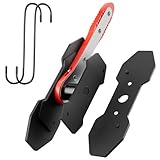
- 【Adding Tower to Your Brake Job!】Your professional brake caliper compression tool! This essential caliper piston compression tool is equipped with an upgraded 360°ratchet that effortlessly and smoothly presses single, dual or quad pistons back in with one hand. No slip, no effort. Fits 95% of cars and light trucks. Magnetic plate makes changing brake pads a breeze. Makes it faster and easier to get the job done.
- 【Simple and Convenient Design】Our caliper compression tool includes: sturdy tool, 2 super strong magnetic steel plates with safety slots and 2 protective hooks. The steel plates fit into place in seconds! The hooks ensure safe braking. The ratchet has a simple flip switch that changes direction instantly. It is very intuitive and anyone can quickly master this brake caliper press tool.
- 【Strong and Durable】Confidence comes from quality. The body of this ratcheting brake caliper tool is corrosion-resistant, high-strength alloy steel that is not easily deformed and can withstand high pressure without bending or breaking. Comfortable, non-slip rubber grips and a clever lever design apply maximum force with minimum effort. Includes large flat plate (7.01”x2.36”) and small flat plate (4.53”x2.17”). Adjustable stretch range: 1.88”(min) to 3.03”(max) for most jobs.
- 【Easy Operation Guide】 Using the brake pad spreader tool is very simple: press the push plate onto the piston, apply pressure to the push plate, swing the handle to extend it, flip the switch to control the direction, and activate the ratchet by applying even pressure, and the piston retracts smoothly! Key tip: Keep it level to avoid sticking or uneven movement. Your reliable caliper tool for perfectly smooth compression.
- 【Keep Your Car Safe at All Times】From garage repairs to traveling emergencies, your brake piston compression tool is easy to carry, use the tool to replace brake pads. Hooks can be used to secure the brake calipers or to protect your hands while working. The ratcheting brake caliper tool can be kept in the trunk to fix brake problems anywhere, anytime.
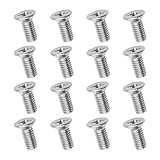
- 【Stainless Steel】: Our car brake disc rotor screws are made of high quality stainless steel, which prevents rust, wear and oxidation. High strength and good toughness, not easy to deform or break. Corrosion-resistant, durable and long service life.
- 【Perfect Brake Work】: These screws hold the brake rotor in place when you put it back on the car tire. After the caliper/tire is put back on, they can be left in place or removed, for best results, apply anti-seize lubricant for later removal.
- 【Replacement OEM Number】: 93600-06014-0H. These new automotive brake disc rotor screws meet or exceed OEM quality standards.
- 【Compatibility】: The screws can perfectly match the front, rear, left and right brake disc rotors of your car. (Note: Not applicable to all cars, we recommend checking the part number of the original car brake disc rotor screws before placing an order)
- 【Easy To Use】: It is very easy to install and remove, you just need to use the corresponding removal tool to remove the old screws, and then rotate the new screws to install them and you are done. 16 x car brake disc rotor screws for your use and replacement needs.
This product presentation was made with AAWP plugin.