
NHTSA ID Number: 10095646
Manufacturer Communication Number: SMB147
Summary
SERVICE MANUAL BULLETIN – PREVENTIVE MAINTENANCE – EMP RADIATOR.
10 Affected Products
Vehicle
NEW FLYER | XCELSIOR | 2008-2017 |
SMB-147B
ISSUE DATE: Feb 16 2016
EMP Radiator – Preventive Maintenance
PM – PREVENTIVE MAINTENANCE
This bulletin provides revised OEM information on the preventive maintenance requirements for the EMP radiator.
This bulletin supersedes all prior information on this subject already provided in your New Flyer Service Manuals. Make this Service Bulletin available to service personnel to inform them of changed information.
SMB147 dated Jul 31 2015 has been revised to:
❒ Provide additional Quarterly inspection requirements.
❒ Add new electrical connector inspection at the 6,000 mile interval.
❒ Add new dielectric grease locations/quantities.
SEOCONTENT-STARTSMB-147B 1 of 7
SERVICE MANUAL BULLETIN
This Service Manual Bulletin is prepared by the Publications Department of New Flyer Industries
Canada ULC. Refer to details below.
The New Flyer vehicles described in this manual may be protected by one or more
patents and design applications or registrations in the United States and Canada,
and in other countries. Refer to “Vehicle Patent Information” in this manual.
Copyright © 2016 New Flyer Industries Canada ULC
ISSUE DATE: Feb 16 2016
SMB-147B
APPLICABILITY
VEHICLE LENGTH 30ft. 35ft. 40ft. 60ft. ALL
VEHICLE TYPE
Xcelsior® MiDi® Invero®
ALL
Low Floor High Floor
FUEL TYPE
Diesel Diesel/Electric CNG LNG
ALL
Fuel Cell Trolley/Electric Battery/Electric
SUBJECT EMP Radiator – Preventive Maintenance
SECTION TITLE PM – PREVENTIVE MAINTENANCE
INITIAL DETAILS This bulletin provides revised OEM information on the preventive maintenance
requirements for the EMP radiator.
This bulletin supersedes all prior information on this subject already provided
in your New Flyer Service Manuals. Make this Service Bulletin available
to service personnel to inform them of changed information.
REV B DETAILS SMB147 dated Jul 31 2015 has been revised to:
❒ Provide additional Quarterly inspection requirements.
❒ Add new electrical connector inspection at the 6,000 mile interval.
❒ Add new dielectric grease locations/quantities.
2 of 7 SMB-147B
SERVICE MANUAL BULLETIN
SMB-147B
The New Flyer vehicles described in this manual may be protected by one or more
patents and design applications or registrations in the United States and Canada,
and in other countries. Refer to “Vehicle Patent Information” in this manual.
Copyright © 2016 New Flyer Industries Canada ULC
1. Weekly Preventive
Maintenance
1.1. Radiator
Test the function of the fan reverse switch
and LED indicator on a weekly basis or
any time service work is being performed
in the engine compartment. Operating the
fan reverse switch will not only clear debris
from the radiator core, but will also confirm
operation of the LED indicator which is
used to display diagnostic fault codes. If
any active fault codes are indicated, refer
to Section 6 of your New Flyer Service
Manual for troubleshooting and vendor
information.
2. Quarterly Preventive
Maintenance
2.1. Radiator
☞NOTE:
The inspection interval is dependent on
local operating conditions. Exposure to
harsh conditions such as salt, dirt, and
debris may require more frequent inspections.
Operating in a less harsh environment,
in combination with regular fan
reversal operation, may allow for extended
inspection intervals.
Inspect and clean the radiator on a quarterly
basis or more frequently if operating
under harsh conditions.
2.1.1. Inspection
1. Check hose connections and tighten
clamps as necessary. Cracked, swollen or
deteriorated hoses must be replaced.
2. Check radiator and charge air cooling
cores for leaks and for accumulation of dirt
which obstructs air passage. As required,
operate the fan reverse button on the
engine gauges panel to assist in removing
debris from the cores. Repair all cooling
system leaks immediately.
3. Inspect the radiator mounting hardware
and tighten mounting bolts when necessary.
4. Inspect for clearance between fan blades
and radiator core and fan shroud.
5. Inspect air recirculation seals at baffles
around radiator assembly. Seals must be
in good condition.
6. Inspect fan blades for cracks, broken tips,
or other damage.
7. Inspect charge air cooler hoses and piping
for leaks, holes, cracks, or loose connections.
8. Inspect the radiator and surrounding area
for evidence of corrosion as follows:
a. Inspect the steel fan shroud that
encloses the radiator for paint damage
or evidence of corrosion. Prime and
repaint exposed surfaces as necessary.
☞NOTE:
Stones and road debris may chip the powder
coating on the steel fan shroud and
provide the potential for corrosion to begin.
If unprotected steel and a salt solution are
allowed to remain on the system, then the
aluminum heat exchanger may also suffer
corrosive damage due to stray voltage.
b. Inspect the lower mounting bracket for
corrosion and accumulation of debris.
Clean, prime, and repaint as necessary.
c. Inspect the bottom of the radiator and
drain plug for evidence of corrosion.
Clean, prime, and repaint as necessary.
d. Inspect the surrounding structural tubing
for evidence of corrosion. Clean,
prime, and repaint as necessary.
9. Repair or replace any defective part. Refer
to Section 6 of your New Flyer Service
Manual for procedure.
SMB-147B 3 of 7
SERVICE MANUAL BULLETIN
SMB-147B
The New Flyer vehicles described in this manual may be protected by one or more
patents and design applications or registrations in the United States and Canada,
and in other countries. Refer to “Vehicle Patent Information” in this manual.
Copyright © 2016 New Flyer Industries Canada ULC
2.1.2. Power Washing
DO NOT use excessive pressure or
place washer wand within close proximity
to radiator/CAC core when power
washing otherwise damage to the fins
could result. Use a pressure of less
than 1200 psi to power wash and maintain
a minimum distance of 9 inches
from the cores. DO NOT direct power
wash at product or safety labels.
The use of steam cleaning or pressure
washing equipment can force moisture
into electrical connectors and cause
corrosion of the terminals Avoid directing
high pressure spray toward any
electrical connectors.
☞NOTE:
Sodium Chloride (rock salt), Calcium Chloride,
and Magnesium Chloride are salts
used for road surface treatment during the
winter months in areas prone to freezing.
These salts are highly corrosive and can
accumulate on the radiator assembly and
must be removed on a regular basis
(monthly when salts are applied to the
roads).
Power wash the fan side and heat
exchanger side of the radiator in accordance
with the following instructions. Use
an effective detergent, following manufacturer’s
instructions, and then flush out the
cleanser using the reverse fan cycle and
low pressure clean water.
1. Clean the exterior of the radiator from the
engine compartment side on an “as
required” basis. Use power wash equipment
at reduced pressures, not exceeding
1200 psi, and maintain a safe distance, no
closer than 9 inches from the heat
exchanger.
☞NOTE:
Use a cleaning solution approved for effective
removal of road grime and safe for aluminum.
In winter months use a solution
that is effective for the removal of road
salts used in the area.
2. Clean the exterior of the radiator from the
streetside of the vehicle on an “as
required” basis. Close the screened radiator
door and maintain a minimum distance
of 12 inches between the wand of the pressure
washing equipment and the screened
door. Reduce power washing equipment to
not exceed 1200 psi.
☞NOTE:
If the radiator cannot be satisfactorily
cleaned to provide proper airflow across
the core, then the unit will need to be
removed from the vehicle for soaking and
cleaning. Refer to 5. “Two Year Preventive
Maintenance” on page 7 in this bulletin for
cleaning procedure.
4 of 7 SMB-147B
SERVICE MANUAL BULLETIN
SMB-147B
The New Flyer vehicles described in this manual may be protected by one or more
patents and design applications or registrations in the United States and Canada,
and in other countries. Refer to “Vehicle Patent Information” in this manual.
Copyright © 2016 New Flyer Industries Canada ULC
2.1.3. Grounding (Bonding) Wires
☞NOTE:
The radiator and coolant tubes are
grounded to the vehicle frame to minimize
any corrosion resulting from electro-potential
differences between dissimilar metals
and exposure to electrolytic (salt) solutions.
It is important that these grounding
connections be maintained.
❒ Inspect all ground wires for wear or frayed
insulation.
❒ Inspect the coolant supply and return
tubes and ensure that the stainless steel
clamps with ground wires are clean, free of
corrosion, and securely attached to the
tubes.
The fan shroud must not be grounded
to the vehicle frame unless the coolant
pipes are also grounded.
❒ Inspect the aft side of the radiator shroud
to ensure that the ground wire connection
is clean, free of corrosion, and securely
attached.
❒ Inspect the three ground wire connection
points on the streetside main frame rail to
ensure that the connections are not corroded
and are securely attached.
2.1.4. System Diagnostic Data
Observe any inactive faults on EMP cooling
systems equipped with diagnostic
capabilities. Connect the EMPower Connect
Service tool to the vehicle diagnostic
port and record any inactive faults. Clear
faults and check for any recurring faults at
subsequent inspections.
SMB-147B 5 of 7
SERVICE MANUAL BULLETIN
SMB-147B
The New Flyer vehicles described in this manual may be protected by one or more
patents and design applications or registrations in the United States and Canada,
and in other countries. Refer to “Vehicle Patent Information” in this manual.
Copyright © 2016 New Flyer Industries Canada ULC
3. 6,000 Miles (9,600 km)
Preventive Maintenance
3.1. Radiator
3.1.1. Radiator Power & Ground Studs
☞NOTE:
This inspection interval is dependent on
operating conditions and exposure to road
salts. Adjust inspection interval to suit conditions.
1. Locate the power and ground studs on the
radiator and pull boots back from passthrough
stud. See “Fig. 1: Radiator Inspection”
on page 5.
2. Wipe grease and any debris from the ring
terminal and stud area. Observe if the
grease is discolored. If the grease is discolored,
thoroughly degrease the area
before proceeding.
3. Examine the assembly and if corrosion is
found, disassemble the ring terminal from
the stud and clean the ring terminals and
studs with a brass wire brush. Replace any
hardware that shows signs of accelerated
corrosion. Reassemble and torque to
specification. Refer to Section 6 of your
New Flyer Service Manual for assembly
torque.
4. Apply dielectric grease to the power and
ground studs on both sides of the passthrough
stud. Slide protective rubber boots
over exposed nuts and studs. Ensure that
the vehicle side power and ground boot is
securely snapped onto the bushing to form
a seal. Refer to 3.1.3. “Grease Requirements”
on page 6 for grease quantity
requirements.
☞NOTE:
Use Dow Corning DC-4 Electrical Insulating
Compound or equivalent. Use a
squeeze tube to dispense 5 grams (which
is nearly enough to fill the insulation boot)
directly onto the stud or into the boot. If
grease is dispensed into the boot, squeeze
the boot after covering the stud to ensure
the grease is worked onto all surfaces of
the stud components.
Fig. 1: Radiator Inspection
3.1.2. Radiator Electrical Connectors
☞NOTE:
This inspection interval is dependent on
operating conditions and exposure to road
salts. Adjust inspection interval to suit conditions.
1. Inspect the fan main harness, ignition,
CAN, and system controller electrical connectors
to ensure they are clean and properly
connected.
2. Ensure harness is properly routed and
secured.
3. Open the connectors and inspect terminals
for dirt or corrosion. Clean as necessary
with contact cleaner and a stiff bristle
brush.
4. Reapply a small amount Dow Corning DC4
dielectric grease to the harness side of the
connector and reconnect. Refer to 3.1.3.
“Grease Requirements” on page 6 for
grease quantity requirements.
s0700363a.svg
????????????????????
????????????????
????????????????????????
????????????????
????????????????????????
????????????????????????????????????????
6 of 7 SMB-147B
SERVICE MANUAL BULLETIN
SMB-147B
The New Flyer vehicles described in this manual may be protected by one or more
patents and design applications or registrations in the United States and Canada,
and in other countries. Refer to “Vehicle Patent Information” in this manual.
Copyright © 2016 New Flyer Industries Canada ULC
3.1.3. Grease Requirements
Use an acid brush to apply a thin coat of
clean dielectric grease to the harness side
of the connector.
☞NOTE:
The fan connectors on systems with 15”
fans do not require dielectric grease.
GREASE REQUIREMENTS
LOCATION GREASE QUANTITY (grams)
Power/Ground Studs with 1 1/8” Dia. Boots 5.0 g
Power/Ground Studs with 1 1/2” Dia. Boots 10.0 g
TMC & CAN Connectors 1.0 g
LED/Pushbutton Connector 0.75 g
Ignition Connector 0.50 g
11” Fan Connector 1.25 g
15” Fan Connector None
SMB-147B 7 of 7
SERVICE MANUAL BULLETIN
SMB-147B
The New Flyer vehicles described in this manual may be protected by one or more
patents and design applications or registrations in the United States and Canada,
and in other countries. Refer to “Vehicle Patent Information” in this manual.
Copyright © 2016 New Flyer Industries Canada ULC
4. Yearly Preventive
Maintenance
4.1. Radiator
Inspect the radiator on a yearly basis as
follows:
❒ Inspect the main positive and negative
power cables for wear or frayed insulation.
Ensure the protective rubber boots are in
place and in good condition.
❒ Check the main power cable connections
for tightness and torque to 20 ft-lb. (27 Nm)
if necessary.
❒ Inspect the condition of the inner and outer
nylon bushings on the main power cable
pass-through studs.
❒ Inspect main wiring harness and connections
to TMC controller and all fans.
❒ Inspect fuses and fuse holders.
❒ Inspect support structure for any damage
or loose mounting hardware.
5. Two Year Preventive
Maintenance
5.1. Radiator
5.1.1. Radiator External Cleaning
Use the following procedure to remove any
buildup of mud, salt, sand, road oils, brake
lining dust, or tire rubber/carbon black from
the exterior surface of the radiator:
☞NOTE:
The interval at which the radiator is
removed for a soak cleaning may be
adjusted to suit the actual operating environment
and radiator condition.
1. Remove the radiator from the vehicle.
Refer to Section 6 of your New Flyer Service
Manual for removal and installation
procedures.
2. Soak the radiator for 24 hours in a hot
(150°F) non-caustic detergent solution with
all fittings plugged.
3. Use low pressure spray equipment with
cleaning solvent to clean the fin louvers.
4. Final rinse with clear water and air dry.
5. Inspect cooling fins and straighten to the
original geometry using needle nose pliers
or a fin comb.
5.1.2. Radiator Internal Cleaning
☞NOTE:
Refer to Cummins Operation and Maintenance
Manual and Cummins Coolant
Requirements and Maintenance Bulletin
3666132 for detailed cleaning and flushing
procedures if performing a complete cooling
system flush. Otherwise proceed with
following instructions if cleaning is
restricted to the radiator only.
1. Flush the core with an aluminum compatible
system flush solvent, following manufacturer’s
instructions.
2. Rinse with clean water and air drySEOCONTENT-END
SMB147B
SMB147
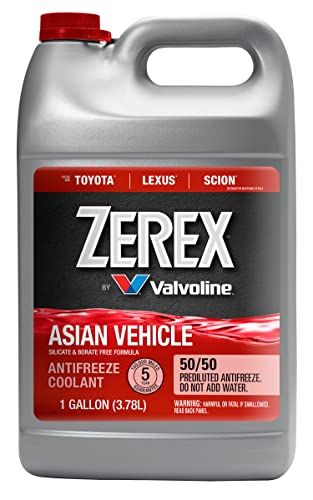
- Formulated to replace the OEM fluid in Asian make vehicles such as Toyota , Lexus , Scion and others requiring a red, silicate free HOAT antifreeze/coolant
- 5 year/150, 000 mile . Silicate-free, long-life, phosphate Hybrid Organic Acid Technology chemistry
- The long life formula provides protection for all cooling system metals from rust and corrosion. The silicate free, borate free formula helps protect against harmful scale and deposits
- Meets the following OEM and industry specifications: JIS K 2234-1994, Hyundai/KIA MS 591-08, Mitsubishi ES-64217, Ford WSS-M97B55-A, ASTM 3306, ASTM D4985, Federal Specification A-A-870A
- Note: Please check the vehicle specification before purchasing the item.


- 5 year/150, 000 mile . Silicate-free, long-life, phosphate Hybrid Organic Acid Technology chemistry
- Formulated to replace the OEM fluid in Asian make vehicles such as Honda, Nissan, KIA, Hyundai and others requiring a blue, silicate free HOAT antifreeze/coolant
- The long life formula provides protection for all cooling system metals from rust and corrosion. The silicate free, borate free formula helps protect against harmful scale and deposits
- Meets the following OEM and industry specifications: Hyundai/KIA MS 591-08, Mitsubishi ES-64217, JIS K 2234-1994, Ford WSS-M97B55-A, ASTM 3306, ASTM D4985, Federal Specification A-A-870A
- Contains 30 – 50 ppm of denatonium benzoate as a bittering agent
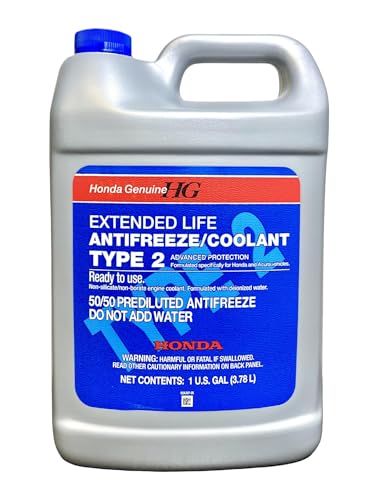
- Genuine Honda Type 2 Long-Life Blue Coolant, pre-mixed 50/50 (ready to use)
- Protects metal and non-metal cooling system parts against corrosion and rust
- Freeze protection and boil-over resistance for extreme temperature performance
- Replaces part number OL999-9011 - matches factory fill for Honda systems requiring Type 2 coolant
- Long service life — up to 5 years or ~60,000 miles under normal conditions
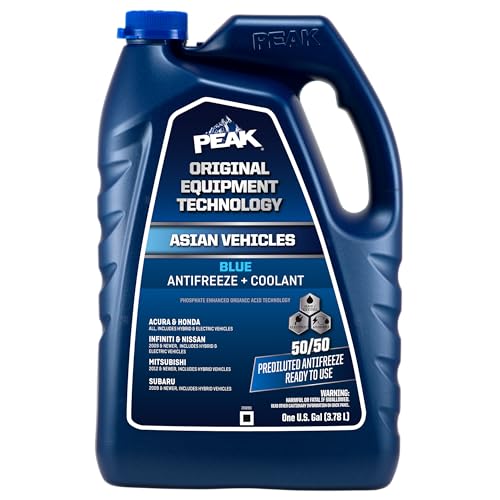
- 1 GALLON ENGINE ANTIFREEZE/COOLANT: Fully compatible with other extended life antifreeze/coolants. This item contains a bittering agent called Denatonium Benzoate.
- PROTECTS: Advanced formulation prevents rust & corrosion protecting all engine cooling system components
- DESIGNED FOR ASIAN VEHICLES: Recommended for use with Acura, Honda, Infiniti, Mitsubishi, Nissan, Subaru, and Suzuki vehicles that require a BLUE Phosphate-enhanced Organic Acid Technology (POAT) formula
- GUARANTEED: When installed as part of a complete flush and fill, PEAK guarantees this coolant will provide service life protection of up to 150,000 miles or 5 years.
- 50/50 PREDILUTED FOR QUICK TOP OFFS: Already diluted to make topping off your cooling system a breeze

- CONCENTRATE ANTIFREEZE AND COOLANT: Efficient formula is compatible with all vehicle cooling systems, providing fast-acting and long-lasting protection on all cooling system metals against rust and corrosion
- NON-ABRASIVE FORMULA: Created with Organic Acid Technology, this ethylene glycol-based coolant formula is compatible with other antifreeze and coolant formulations. This item contains a bittering agent called Denatonium Benzoate.
- ALL VEHICLE: Versatile and formulated for use in all American, Asian, and European automobiles including cars and low/medium to heavy duty trucks of all makes, models, and years
- SAFE FOR FILLS AND TOP-OFFS: The amber color will not effect the antifreeze currently in your cooling system
- LIFETIME PERFORMANCE: Provides cooling system protection for your automobile's entire lifetime with proper maintenance
This product presentation was made with AAWP plugin.