
August 18, 2021 NHTSA CAMPAIGN NUMBER: 21E076000
A cracked crane base could fail and pull away from the truck mount, increasing the risk of injury.
NHTSA Campaign Number: 21E076
Manufacturer Palfinger, Inc.
Components EQUIPMENT
Potential Number of Units Affected 890
Summary
Palfinger, Inc. (Palfinger) is recalling certain Knuckle Boom Cranes, models PW38001, 42001, and 50001. The crane base may crack over time from normal crane use.
Remedy
The remedy has not yet been identified. The manufacturer has not yet provided a schedule for recall notification. Owners may contact Palfinger customer service at 1-712-256-9347.
Notes
Owners may also contact the National Highway Traffic Safety Administration Vehicle Safety Hotline at 1-888-327-4236 (TTY 1-800-424-9153), or go to www.nhtsa.gov.
General
PALFINGER has become aware of a design issue on the base of the PW crane range (base type S419).
Between the turntable and the balance of the base, we have seen indications that a very localized area is not resisting the stress of normal use over the calculated lifetime of the crane. As a result, some bases have cracked after a few years. Whether a crack develops is largely dependent on applied working cycles and slewing angles at which the crane has been used.
With the implementation of periodic visual inspections pursuant to instructions in the operator’s manual, an immediate failure of the affected component can be prevented.
The performance of such periodic inspections can disclose the existence of a crack at its early, non-dangerous stage.
PALFINGER has decided to initiate mandatory inspections for cracks on the affected component. As described below, cracks smaller than a certain size can be repaired. Bases containing larger cracks must be replaced.
In addition, in order to improve the durability of all of these products, PALFINGER has decided to reinforce all existing bases in this product line. We hope this effort will show PALFINGER’s dedication to customer satisfaction.
Any bases produced in PALFINGER’s factories in Europe after August 15, 2021 have already been modified and do not need reinforcement.
Affected Products
Base S419G30SA and its updated design S419G30SB
used on models PW 38001, PW 42001-SH, PW 38001EL, PW 50001-SH
Description
Location
The affected area is located between the turntable and the balance. This area is accessible for an inspection without removing the crane, if the crane is mounted behind the cab.
It might be necessary to remove the crane to carry out a repair or a reinforcement if the area is not sufficiently accessible (such as on installations behind the cab).
August 19, 2021
IMPORTANT SAFETY RECALL
This notice applies to your vehicle. See attached serial number list.
NHTSA Safety Recall No. 21E076
Dear Palfinger Dealer:
This notice is sent to you in accord with the National Traffic and Motor Vehicle Safety Act.
Palfinger, Inc. has determined that a defect relating to motor vehicle safety exists in certain models of its knuckle boom cranes. The affected models are made with a crane base that may develop cracks early in its working lifecycle that could cause crane failure and uncontrolled movement that could result in serious personal injury or death.
Refer to R-NC-2103 for the items covered under this recall. To determine or confirm if your units are included in this recall, compare the serial numbers of your units to those attached to this notice.
The procedures for crane base inspection and/or repair are included in the attached R-NC-2103. Visual inspections can be performed by the customer/owner, but your guidance is required to ensure a proper result. All repairs will need to be performed by you, or you can contact Palfinger at 1-800-567-1554 for further assistance. Depending on the extent of the base crack at the time of inspection, required repairs are expected to take anywhere from 30-60 hours.
If you have already performed the repairs outlined in the attached R-NC-2103, before receiving this letter, you may be eligible for reimbursement of the cost associated with your pre-notification work covered under this recall. You may contact Palfinger at 1-800-567-1554 for more details.
For all cranes that you have leased or sold that are included in this recall, you are required by Federal Law to forward a copy of this notice to their owners by first-class mail within 10 days of your receipt of this notice.
For U.S. owners: if after contacting your dealer or Palfinger at 1-800-567-1554, you are still not able to have the safety condition remedied within a reasonable time, you may write to: Administrator, National Highway Traffic Safety Administration, 1200 New Jersey Avenue SE, Washington, DC 20590 or call 1-888-327-4236 (TTY: 1-800-424-9153) or go to https://www.safercar.gov.
We are sorry to cause this inconvenience; however, we are taking this action in the interest of your safety and that of your customers, as well as to ensure your continued satisfaction with Palfinger products.
Thank you for your immediate attention on this important matter.
Sincerely,
William J. Fenton, ASQ CMQ/OE
Regional Quality Manager Quality
Regional Operations
PALFINGER NORTH AMERICAN REGION
3501 South 11th Street
Council Bluffs, IA | USA
SEOCONTENT-START Repair Instruction Loader Crane PW Crane Crane base repair welding Version: 2021/08 RA9-53 English PALFINGER AG Lamprechtshausener Bundesstraße 8 5101 Bergheim | Austria www.palfinger.com Contents www.palfinger.com 3 Contents 1 General …………………………………………………………………………………………………………………….4 1.1 Introduction and handling of this document ………………………………………………………4 1.2 Validity ………………………………………………………………………………………………………..4 1.3 Symbols in this document ………………………………………………………………………………5 1.4 General safety instructions …………………………………………………………………………….5 2 Introduction ……………………………………………………………………………………………………………..6 3 Important information about welding repairs …………………………………………………………….7 3.1 General ……………………………………………………………………………………………………….7 3.2 Welder’s qualification, documentation ……………………………………………………………..7 3.3 Component material ……………………………………………………………………………………..7 3.4 Reinforcing plate …………………………………………………………………………………………..8 3.5 Filler material ……………………………………………………………………………………………….8 3.6 Preheating temperature / interpass temperature ……………………………………………….8 3.7 Welding parameter ……………………………………………………………………………………….8 4 Preparation work ………………………………………………………………………………………………………9 4.1 Accessibility …………………………………………………………………………………………………9 4.2 Working steps ………………………………………………………………………………………………9 5 Repair work …………………………………………………………………………………………………………… 10 5.1 Crack repair ……………………………………………………………………………………………… 10 5.2 Reinforcing plate ……………………………………………………………………………………….. 12 5.2.1 Filled welding seam area………………………………………………………………. 12 5.2.2 Adjust and tack reinforcing plate ……………………………………………………. 13 5.2.3 Tack weld reinforcing plate……………………………………………………………. 14 5.2.4 Requirements of welding parameters and conditions ……………………….. 15 5.2.5 Step by step execution of welding ………………………………………………….. 17 6 Finalization of work ……………………………………………………………………………………………….. 19 Version Remarks 2021/08 Creation of this document General PW Crane 4 www.palfinger.com 1 General 1.1 Introduction and handling of this document This PALFINGER original repair instruction is a technical description of repairs on a loader crane. It will be handed out at PALFINGER and should serve as a reference book for service and repair work. This document is mainly addressed to specialized companies and PALFINGER service workshops. Appropriate product knowledge and basic product education is required A corresponding product understanding and a basic training for the respective products are required. 1.2 Validity This repair instruction is valid without any time limitation for the described system. However, it is possible, that through further developments new versions of this document could be available. PALFINGER reserves the right to change this document at any time. No legal claims can be derived from this document. Country-specific laws, standards and directives must be observed. © Copyright by PALFINGER Duplication, also in extracts, is only permitted with written permission of PALFINGER. PW Crane General www.palfinger.com 5 1.3 Symbols in this document The following symbols and signal words are mentioned in this document: DANGER Situation, that will lead to death or serious injuries. WARNING Situation, that could lead to death or serious injuries. CAUTION Situation, that could lead to minor injuries. ATTENTION Situation, that could lead to material damage. PLEASE NOTE Information, which makes working with the unit easier. IMPORTANT INFORMATION Important information for the user. 1.4 General safety instructions WARNING During all service and repair work the appropriate safety devices must be worn. WARNING When working in conjunction with electrical and/or electronic components, ensure that no voltage is applied. WARNING Before carrying out service and/or repair work the unit must be pressure less. WARNING After service and/or repair work a function/pressure test must be carried out. Introduction PW Crane 6 www.palfinger.com 2 Introduction This instruction refers to the PALFINGER Recall R-NC-2103_PW Range Base Cracks and explains how to weld a reinforcing plate (2, drawing) onto the connection plate (1) on crane base S419G30SA respectively S419G30SB used on the following PW crane models: PW 38001 PW 42001-SH PW 38001EL PW 50001-SH The following illustrations localizes the area of the reinforcement. Illustration 09-53- 1: Affected area Further information about welding can be found in chapter 4 of the mounting instruction “Welding on bodywork and crane”. This instruction must be obeyed. With the help of this document, the repair can be carried out from appropriate trained and certified persons. PLEASE NOTE Only qualified welders with an valid certificate according to EN ISO 9606-1 respectively EN287-1 or an adequate national standard is allowed to carry out the repair. The certificate must be valid for the full range of the executed welding task. Preparation work, such as dismounting of crane from vehicle, remounting etc. is not explained in detail in this instruction. All preparation work must be carried out self-reliant. This instruction explains the repair welding and all the connected tasks step by step. 1 2 1 PW Crane Important information about welding repairs www.palfinger.com 7 3 Important information about welding repairs PLEASE NOTE Chapter 4 of the installation guideline “Welding on bodywork and crane” must be obeyed. The installation guideline is available on PALDESK. Chapter 3 includes important facts about welding related to the repair which must be obeyed. Ensure to clearly understand those basic guidelines. 3.1 General Working- and safety standards must be respected, especially the issue fire prevention. Provide fire extinguisher during the repair work. Ensure repair area is clean and free of paint before starting welding works. Grind out cracks according to specifications in this instruction. Clean and process the welding gap. Welding under the terms of available WPS (Welding Procedure Specification) according to EN ISO 15613 or EN ISO 15614 or similar valid regulations. After the repair the area must undergo a verification. 3.2 Welder’s qualification, documentation The needed welder’s qualification for the repair are following: EN 9606-1 135 P FW FM2 S s8 PF ss sl mb EN 9606-1 135 P BW FM2 S s10 PC ss ml nb In case of other country specific standards and regulations, the valid welder qualification must be at least the same level or an higher level as the standards mentioned above. In general the welder is self-responsible to ensure appropriate welding quality. PALFINGER requires the following documentation for each case: To proof the carried out repair work and to document the case, a picture of the final repair work has to be taken before painting. This has to be included to the warranty claim (refer to recall R-NC-2103). 3.3 Component material The crane base and the reinforcing plate are both made of the following material: Sheet metal S690 Important information about welding repairs PW Crane 8 www.palfinger.com 3.4 Reinforcing plate To carry out the repair, a reinforcing plate has been designed and has to be ordered from the PALFINGER parts center. The part number of the reinforcing plate is HA22914. Illustration 09-53- 2: Reinforcing plate HA22914 3.5 Filler material The welding must be carried out using the following filler material: Welding wire (PALFINGER standard „Z2“) Böhler X70-IG / ISO 16834-A: G 69 5 M Mn3NiCrMo with 1 mm wire diameter. Welding wire (PNAG standard „E110“) Lincoln Electric SUPERARC LA-100 / AWS A5.28: ER110S-G. PALFINGER part number for the welding wire (Böhler) is W10007363 (18kg coil). For MAG M welding, protective gas M20 or M21 according to EN 14175 must be used. 3.6 Preheating temperature / interpass temperature The temperature in the welding area must be at least 20 °C (68 °F). If the environment temperature is less than this, preheating is required. The allowed maximum interpass temperature is 150 °C (302 °F). In general the definition of the correct temperature range is the responsibility of the welding supervisor in charge. 3.7 Welding parameter The welding parameters must be selected and set by the responsible welding engineer who is performing the repair welding. PW Crane Preparation work www.palfinger.com 9 4 Preparation work 4.1 Accessibility It is of essential importance to have access to the affected area during all repair works. Therefore removing the crane might be necessary (especially on front mounted cranes, as on most vehicles in the US). On rear installations (as most common in Canada), sufficient accessibility might be given by just removing the balance. It is in the responsibility of the welder and his supervisor, to decide, if a removal is necessary or not. 4.2 Working steps The following steps are required in any case, whether a crack is present or not. Remove the crane if necessary (refer to point 4.1) using proper equipment and place it safely. Remove the balance to grant accessibility. Dismount attached parts interfering the working area. IMPORTANT INFORMATION The repair weld can be carried out with the column in place. There is no need to take out the column on assembled cranes. Clean the working area properly, especially remove all grease. To avoid damage to the surrounding area, take appropriate precautions. Protect the nearby area with welding blankets or something similar while carrying out the repair work. Provide fire extinguisher (refer to point 3.1). Take off the part identification plate (1). This plate must be reinstalled on a different position after the work is finished. Use grinder to remove the paint, the area has to be blank, clean and free of grease (2). Illustration 09-53- 3: Remove part plate Illustration 09-53- 4: Grinded welding area, ready for repair work The preparation work is now completed. 1 2 Repair work PW Crane 10 www.palfinger.com 5 Repair work The following chapter describes how to carry out the repair work in detailed steps. The chapter is divided in two sub-chapters: ➔ Crack repair (only applicable, if a crack is present) ➔ Reinforcing plate (always applicable) If no crack is present, skip chapter “5.1 Crack repair”. IMPORTANT INFORMATION If the situation is uncertain whether a crack is present or not, use a dye penetration test for verification (if this method is not clear, contact PALFINGER for guidance). 5.1 Crack repair This chapter is only valid, if a crack is present (before adding the reinforcing plate HA22914 it is essential to repair the crack). Grind out the crack (1) over its entire length with a minimum depth of 6 mm (¼’’) and a maximum depth of 10 mm (⅜’’). It is allowed, that a lack of penetration of 2 mm (1/16’’) is still visible after grinding in a depth of 10 mm (⅜’’). Be aware that the plate has a thickness of 12 mm (½’’). Do not grind completely through the plate. Grind out the crack over its entire length. Illustration 09-53- 5: Area after grinding CAUTION Only cracks not touching the critical zone are repairable. If a crack touches the critical zone, the base must be changed. 1 PW Crane Repair work www.palfinger.com 11 Definition of the critical zone A crack (2) is in the critical zone if it reaches into the critical area (1) in either the right or the left side. This area (1) is 70 mm (2¾”) long on each side, measured on the welding seam from the outside towards the center. Illustration 09-53- 6: In uncertain cases, use a dye penetration test to clearly identify whether a crack touches the zone or not. Place an appropriate welding seam (3) onto the grinded out area. Grind area even (4) so the reinforcing plate can be placed properly afterwards. 3 Welding seam 4 Grinded weld Illustration 09-53- 7: Affected area After the crack is rewelded and grinded even, further points must be checked before the reinforcing plate is installed. 3 4 1 1 2 Repair work PW Crane 12 www.palfinger.com 5.2 Reinforcing plate 5.2.1 Filled welding seam area Because of the design and the welding specifications, the affected area can show itself with or without a “filled” welding preparation. A filled welding preparation is given, if the welding seams completely fill the welding seam area to the edge of the plates (refer to picture situation 2). Illustration 09-53- 8: Unfilled situation, additional welding seams required Illustration 09-53- 9: Filled situation, ready to install reinforcing plate To assure a proper connection between the connection plate and the reinforcing plate, a filled situation must be given. For this reason it is possible, that the welding area must be filled with additional welding seams (1) before the reinforcing plate gets installed. IMPORTANT INFORMATION The steps mentioned above are not necessary in all cases but could be needed in some. In most cases a “filled” situation is given so the reinforcing plate can be installed straight away. Grind the area after filling to ensure an even surface for the reinforcing plate. 1 2 1 2 PW Crane Repair work www.palfinger.com 13 Welding seams are ready (1) to install the reinforcing plate in order to get a perfect connection in between the connection plate and the reinforcing plate and also with the other parts affected by the reinforcing action. Illustration 09-53- 10: Welding seams ready to install reinforcing plate 5.2.2 Adjust and tack reinforcing plate As soon as the area is prepared properly, the reinforcing plate can be fitted and tacked onto the connection plate. Illustration 09-53- 11: Working area prepared for installation of reinforcing plate 1 Repair work PW Crane 14 www.palfinger.com The part number of the reinforcing plate is: HA22914. It can be ordered from the PALFINGER parts center. CAUTION The reinforcing plate must be clean and free of any contamination. It must fit flat and even on the reinforcing area. There must be no gap in between the plates. If it is not, it has to be adapted until it does fit properly. For this it could be necessary that the plate needs to be bent additionally. It also is possible, that it needs to be grinded in some areas in order to make it fit properly. Illustration 09-53- 12: Top side with welding bevel Illustration 09-53- 13: Bottom side 5.2.3 Tack weld reinforcing plate Align the plate and tack it. Start tacking on the left side (1, 2), continue on the right side (3, 4). Tack the reinforcing plate with 8 tack welds in total. Illustration 09-53- 14: Tack welds NOTE Make sure, the tack welds are placed as shown on the picture above. Otherwise there could be an incomplete fusion during the welding procedure. 1 2 3 4 5 7 6 8 PW Crane Repair work www.palfinger.com 15 5.2.4 Requirements of welding parameters and conditions This chapter explains basic settings, requirements and conditions which have to be obeyed during the welding work. The following illustrations are showing the order of the different layers. The execution is explained in the next chapter. Illustration 09-53- 15: Welding sequences front view Illustration 09-53- 16: Welding sequences side view Repair work PW Crane 16 www.palfinger.com The specifications on the chart below defining gas flow and allowed temperature range must be obeyed during the repair. Small deviations due to different welding equipment used on site are allowed. Gas M21-ArC-18 15 l/min Filler material “Z2” Böhler X 70-IG 1 mm Min. preheating temperature 20 °C (68 °F) Max. interpass temperature 150 °C (302 °F) The following parameters / settings are guide values and have to be used to carry out the repair. Also here, small deviations due to different welding equipment used on site are allowed. If other welding equipment will be used, the parameters must be qualified according to the welding standards and must be verified before starting the repair welding. It is in the responsibility of the local welding engineer to fulfil the welding standard requirements (AWS, ISO). Pass Process Pos. Filler material diameter Amperage A Voltage V Wire feed m/min Welding speed cm/min 1 135 PF 1,0 144 16,8 6,4 8,2 2 135 PF 1,0 144 16,8 6,4 8,2 3 135 PC 1,0 250 25,5 12,6 46,0 4 135 PC 1,0 220 24,9 11,1 46,0 5 135 PC 1,0 220 24,9 11,1 46,0 6 135 PC 1,0 220 24,9 11,1 46,0 7 135 PC 1,0 250 25,5 12,6 46,0 8 135 PC 1,0 220 24,9 11,1 46,0 IMPORTANT INFORMATION Always obey the weld preparation in between the layers (cleaning of welding seam, grinding overlap area etc.). IMPORTANT INFORMATION The authorized person on site is responsible for the correct execution of the repair and welding procedure. PW Crane Repair work www.palfinger.com 17 5.2.5 Step by step execution of welding The following pictures show the welding process step by step. This picture documentation is equal to the welding order explained at the beginning of this chapter. PLEASE NOTE To avoid incomplete fusion, all welding seams must be executed in one step without stop. The first welding seams on the left and right side of the reinforcing plate are carried out as uphill weld. Make sure that the welding is continued on over the edge of the plate to avoid incomplete fusion on further welding seams. Welding seam 1 lateral uphill on the left side (1). Welding seam 2 lateral uphill on the right side (2). Illustration 09-53- 17: Left side Illustration 09-53- 18: Right side Welding seam 3 top edge from the right to the left (3). Welding seam 4 lower edge from the right to the left (4). Illustration 09-53- 19: Upper side Illustration 09-53- 20: Lower side Make sure that the welding seam is cleaned with a brush or an angle grinder before placing the next layer. Illustration 09-53- 21: Cleaning Illustration 09-53- 22: Cleaning 1 2 4 3 Repair work PW Crane 18 www.palfinger.com Welding seam 5 top edge from the right to the left (5). Welding seam 6 lower edge from the right to the left (6). Illustration 09-53- 23: Upper side Illustration 09-53- 24: Lower side Grind out (clean) welding seam before starting welding. Welding seam 7 top edge from the right to the left (7). Welding seam 8 lower edge from the right to the left (8). Illustration 09-53- 25: Upper side Illustration 09-53- 26: Lower Side Welding of reinforcing plate is finished. Illustration 09-53- 27: Welding finished 5 6 7 8 PW Crane Finalization of work www.palfinger.com 19 6 Finalization of work Check and grind weld run outs (1). Make sure, that the area is free of notches (remove all stress raisers). Illustration 09-53- 28: Grinded weld run outs Illustration 09-53- 29: Angle grinder Welding finished and finalized with grinded weld run outs. Illustration 09-53- 30: Grinded weld run outs Clean the complete welding area with wire brush or similar tool. Take off paint on the side plate of base and reinstall part identification plate at the new position (2). Illustration 09-53- 31: New position of the part identification plate (2) on the side of the crane base. 2 1 1 1 1 1 Finalization of work PW Crane 20 www.palfinger.com Let the area cool down (do not use water or similar to cool it down in a quicker way). Clean welding area completely and repaint with primer and final coat. Remount all parts which have been removed earlier. Grease balance bearing and install balance. Remount crane on truck again. PLEASE NOTE After the work is finished and the crane is mounted on the truck again, carry out a function test to ensure proper crane functionality. Only when assured that all systems are working correctly, the vehicle can be handed over to the customer again. ************************************************************************************************************************ PALFINGER Europe Kapellenstraße 18, 5211 Friedburg-Lengau | Austria | August 16th, 2021 NAM Crane Service Managers www.palfinger.com Seite 1 / 6 R-NC-2103 PRODUCT RECALL PW Range Base Cracks (S419) 1 General PALFINGER has become aware of a design issue on the base of the PW crane range (base type S419). Between the turntable and the balance of the base, we have seen indications that a very localized area is not resisting the stress of normal use over the calculated lifetime of the crane. As a result, some bases have cracked after a few years. Whether a crack develops is largely dependent on applied working cycles and slewing angles at which the crane has been used. With the implementation of periodic visual inspections pursuant to instructions in the operator’s manual, an immediate failure of the affected component can be prevented. The performance of such periodic inspections can disclose the existence of a crack at its early, non-dangerous stage. PALFINGER has decided to initiate mandatory inspections for cracks on the affected component. As described below, cracks smaller than a certain size can be repaired. Bases containing larger cracks must be replaced. In addition, in order to improve the durability of all of these products, PALFINGER has decided to reinforce all existing bases in this product line. We hope this effort will show PALFINGER’s dedication to customer satisfaction. Any bases produced in PALFINGER’s factories in Europe after August 15, 2021 have already been modified and do not need reinforcement. 2 Affected Products Base S419G30SA and its updated design S419G30SB used on models PW 38001, PW 42001-SH, PW 38001EL, PW 50001-SH 3 Description 3.1 Location The affected area is located between the turntable and the balance. This area is accessible for an inspection without removing the crane, if the crane is mounted behind the cab. It might be necessary to remove the crane to carry out a repair or a reinforcement if the area is not sufficiently accessible (such as on installations behind the cab). Affected area The plate between the turntable and the balance has to bear high stresses during operation. The area in the oval is the localized area where cracks may develop and which needs to be reinforced using an additional plate. www.palfinger.com Page 2 / 6 PW R-NC-2103 Range Base Cracks (S419) 3.2 Visual inspection PALFINGER has decided to order a proactive visual inspection on all possibly affected cranes on the market. This must be carried out the following way: 1) Determine how many cranes are in your area of responsibility • Your cranes are set forth in the attached list of sold cranes, which has been prepared for you as an authorized PALFINGER Service Entity. • Understand that there is a higher priority on cranes with an “in-Service” date of 2018 and earlier and a lower priority on cranes sold 2019 and later. 2) Visit every customer for a visual inspection • Check higher priority cranes (2018 and older) first (refer to attached list of affected cranes) • Clean the affected area and check for the presence of a crack. The crack is visible when present and therefore a visual inspection is sufficient without additional methods. • To increase the visibility of a possible crack, extend the crane horizontally over the outrigger beam during this check (in the opposite direction of the balance; this is towards the rear of the truck in most cases). • The visual inspection can also be carried out by the end customer. In this case, your guidance is required to receive a clear result. Ensure that the “inspector” clearly understands the previous two bullet points. Above left: Crane extended and ready for inspection (with load in this case, but the empty fork is enough) Above: Inspection area, crane installed behind cab. Left (both pictures): Examples of cracks. The first picture shows an already grown crack, easily visible. The second one a “young” crack, which is safe at this stage but more difficult to recognize. Look carefully! www.palfinger.com Page 3 / 6 PW R-NC-2103 Range Base Cracks (S419) • If no crack is visible Crane is safe to work. Arrange a workshop visit for a preventive repair within the next 6 months (refer to point 4.4). Ask the customer to carry out a visual inspection every month, as explained in the maintenance section of the operator’s manual. • If a crack is found Prioritize the issue following point 4.1 – 4.3 depending on the size of the found crack Arrange for and carry out a repair as soon as possible. If the total crack length is shorter than 3” and a repair is not immediately possible, a dye penetration test to clearly understand its dimension is additionally helpful (if this method is not clear, contact PALFINGER for guidance). Follow point 4.1 – 4.3 based on the priority of the case 4 Repair procedure PALFINGER has designed a reinforcement plate, which must get installed on all cranes on the market, whether a crack is found or not. Repair plate The reinforcement plate HA22914 has been designed for repair and preventive reinforcement. The plate is available at the PALFINGER Parts Center (PPC). Be sure to order the needed quantity to cover the upcoming repairs. Based on the findings during the visual inspection (refer to point 3.2), the cranes must be prioritized for repair the following way: • Priority “A”: Crack in the critical zone. This is an unrepairable crack. Follow point 4.1. • Priority “B”: Crack longer than 3” but not touching the critical zone. Follow point 4.2. • Priority “C”: Crack 3” long or less. Follow point 4.3. • Priority “D”: No crack found. Follow point 4.4. Definition of the critical zone Remove the paint before evaluating a crack for its priority. A crack is in the critical zone if it reaches into the critical area (1) in either the right or the left side. This area (1) is 70 mm (2¾”) long on each side, measured on the welding seam from the outside towards the center. If there is a crack that reaches into the critical area, the base cannot be repaired anymore. This is then a priority “A” case. As long a crack is only present in the zone (2), a repair is possible. In uncertain cases, use a dye penetration test to clearly identify whether a crack touches the zone or not. 1 1 2 www.palfinger.com Page 4 / 6 PW R-NC-2103 Range Base Cracks (S419) 4.1 Priority “A”: Crack present in the critical zone • If a crack is found in the critical zone, a repair is not possible anymore, the base must be replaced. • PALFINGER calls this a priority “A” case. • Tell the customer to cease operation and to ground the crane. • Contact PALFINGER Service and order a new base (S419G30SB). When base arrives, check if it is a reinforced one, otherwise carry out the repair as explained in RA9-53 (most of bases will arrive reinforced from factory). • Organize a repair immediately with the customer and replace the base. • Document the case (refer to point 6) and claim it to PALFINGER (refer to point 7). 4.2 Priority “B”: Crack present longer than 3”, not touching the critical zone • If a crack is found over 3” long but does not touch the critical zone, a repair is possible. The crane is at a critical stage. • PALFINGER calls this a priority “B” case. • Tell the customer to cease operation and to ground the crane. • Inform PALFINGER Service about the presence of the crack and carry out the repair according to the attached repair guideline (RA9-53) and the general PALFINGER welding instruction. • Document the case (refer to point 6) and claim it to PALFINGER (refer to point 7). 4.3 Priority “C”: Crack present with 3” length or less • If a crack is found with a 3” length or less, a repair is possible. The crane is still safe to use. • Tell the customer that a short crack is present and that a repair is required within 3 weeks. • Inform the customer that the crane can still be used but the crack must be observed daily. If the crack grows over 3”, tell the customer to cease operation and to get in touch with PALFINGER. • Organize a repair within 3 weeks and carry out the repair according to the attached repair guideline (RA9-53) and the general PALFINGER welding instruction. • Document the case (refer to point 6) and claim it to PALFINGER (refer to point 7). 4.4 Priority “D”: No crack found • In this preferrable and most common case, no immediate action is needed. A reinforcement repair must be scheduled for no later than 6 months after the inspection. • Ask the customer to carry out a monthly visual inspection, as explained in the maintenance section of the operator’s manual. • Arrange a date for this job, but reserve time and space for higher priority cases until all machines under your responsibility are checked. (Based on time and availability, the repair can be carried out immediately). • Claim the repair to PALFINGER (refer to point 7). www.palfinger.com Page 5 / 6 PW R-NC-2103 Range Base Cracks (S419) 5 Measures on market • The visual inspection must be carried out as soon as possible, no later than the End of September 2021. • Depending on the result of this inspection, the described type of repair has to be carried out (refer to the notes under point 4). • If no crack is present, the reinforcement action has to be completed no later than the End of March 2022. • PALFINGER tracks these repairs using claim management software. It is therefore essential to get every case reported as soon as possible after carrying out the repair (using a claim, refer to point 7). • For cases without cracks found: If the crane is inspected but the repair is not carried out immediately, a claim reporting the visual inspection must be sent as well (refer to point 7). 6 Case documentation • It is very important for PALFINGER to get proper documentation of all inspections and repairs. • Therefore, the following things must be submitted with all claims (including visual inspections): o Overview picture of the truck (side view) o Picture of the area at inspection (with or without crack) o Picture of the crack before repair (if applicable) o Picture of the carried-out repair work before painting (if applicable) o Current Paltronic (PSY) file of the crane, taken at the time of the repair 7 Warranty handling A warranty claim can be made to PALFINGER using the standard procedure (claim management system) under the conditions described below. Two prefilled claims are already available for the repair under the equipment number, one for the inspection, one for the repair. Data must reflect the measurements taken during the inspection. Mileage can also be claimed following the PALFINGER warranty guidelines. 1. For the visual inspection without repair (required for all cranes) Labor time 1 h (no material to be added) Fault code MGG 1240 / SON 1030 Fault causing part R-NC-2103_Inspection 2. For adding the reinforcement plate (with our without prior crack, priority B, C or D) Material HA22914 (reinforcement plate) Labor time 16 h preparation, plate adding and painting +8 h if crane had to be dismounted from the truck Fault code MGG 1240 / SON 1030 Fault causing part R-NC-2103_Repair 3. For base replacement (priority A) Material S419G30SB Labor time 60 h Fault code MGG 1240 / SON 1030 Fault causing part R-NC-2103_Repair www.palfinger.com Page 6 / 6 PW R-NC-2103 Range Base Cracks (S419) 8 Attachments 1. Repair instruction RA9-53 2. List of the affected cranes 9 Release information PALFINGER published this document in English. All other languages are translations. Franz Mayr, Todd Ethier Balthasar Gwechenberger Created August 16th, 2021 Approved August 16th, 2021 Translated SEOCONTENT-END
1 Affected Product
Equipment
| BRAND | PART NO. | PRODUCTION DATES |
| PALFINGER | KNUCKLE BOOM CRANE | |
10 Associated Documents
Recall Quarterly Report #1, 2021-3
RCLQRT-21E076-5123.PDF 211.101KB
Recall Quarterly Report #2, 2021-4
RCLQRT-21E076-1914.PDF 211.193KB
Recall Quarterly Report #1, 2021-3
RCLQRT-21E076-0598.PDF 211.193KB
Recall 573 Report – Amendment 2
RCLRPT-21E076-6391.PDF 214.678KB
Safety Bulletin
RCSB-21E076-0586.pdf 779.451KB
Defect Notice 573 Report
RCLRPT-21E076-5725.PDF 213.546KB
Recall Acknowledgement
RCAK-21E076-9657.pdf 646.983KB
Remedy Instructions and TSB
RCRIT-21E076-6554.PDF 1658.395KB
Manufacturer Notices(to Dealers,etc)
Recall 573 Report – 1/26/2022
RCLRPT-21E076-5475.PDF 214.676KB
Latest Recalls Documents

- Over 75 Years of Play: Tonka toys are proudly passed down through generations for over 75 years. Designed to foster imaginative play, Tonka is a trusted brand that connects generations of families and creates memories that last a lifetime.
- Tonka Tough: Trust the Tonka name for high-quality toys that last. Constructed with steel and sturdy plastic, the Steel Classics Mighty crane can withstand even the the heaviest of loads.
- Realistic Actions: Made Tonka tough and designed to last a lifetime, the Tonka Mighty Crane is made of cold-rolled steel, stands 23" high and is made with colorful and realistic detail . It rotates, lifts, and carries - just like a real crane!
- There is only 1 Tonka: Tonka inspires kids to put down their screens and get back to real play. Tonka’s sturdy trucks inspire active, open-ended playtime for kids either outdoors or in, instead of passive, stationary screen time.


- WORKING CRANE ARM: This construction crane toy features a rotating cabin, extendable boom arm, and movable crane for lifting and moving pretend loads. One of the best toy trucks for kids, it inspires imaginative construction play while exploring realistic vehicle functions.
- LIGHTS & SOUNDS: This toy crane truck features built-in lights and realistic sound effects for exciting construction play. One of the most engaging heavy equipment toys, it inspires imaginative job site adventures, hands-on role-play, and screen-free fun while encouraging creativity.
- SKILL-BUILDING PLAY: This construction vehicle toy set helps kids develop fine motor skills, hand-eye coordination, spatial awareness, and problem-solving. Ideal as one of the best engineering toys for toddler play, it encourages building, lifting, and imaginative construction adventures.
- DURABLE CONSTRUCTION: Made from durable, BPA-free materials with smooth, child-friendly edges, this crane truck is built for lasting indoor and outdoor play. A great choice for kids heavy equipment toys and engineering toys for kids, it offers durability, safety, and hours of imaginative fun.
- GREAT GIFT IDEA: This construction truck toy is perfect for boys and girls ages 3+. The crane toy truck makes a fun gift for birthdays, holidays, classroom rewards, or everyday surprises, encouraging imaginative play, creative storytelling, and hands-on construction adventures.

- 【Full Function RC Crane Toy】This realistic 12-channel RC crane toy features forward and backward movement, left and right steering, boom lifting, hook lifting, a 720° rotating platform, mist spray, LED lights, realistic sounds and an auto-demo mode. Kids can enjoy immersive construction adventures indoors or outdoors while experiencing realistic crane operation and hands-on play
- 【2.4GHz Long-Range Control】This 2.4GHz remote control crane delivers responsive control with a range of up to 82 ft for smooth indoor and outdoor operation. Its strong anti-interference signal allows multiple RC construction vehicles to operate at the same time without signal interference, making construction play even more exciting with friends and family
- 【Safe & Durable Design】Built with a tough, drop-resistant ABS body and durable alloy hook, this remote control crane is designed for long-lasting construction fun. The secure battery compartment with a screw-lock cover helps keep the batteries safely in place during active play for added peace of mind
- 【All-Terrain Rubber Tracks】This RC crane toy features durable anti-slip rubber tracks that provide strong traction and smooth movement across grass, gravel, sand, dirt and indoor floors. Built for realistic construction adventures, it delivers stable performance on multiple terrains for even more exciting play
- 【Realistic Lifting Experience】The lifting boom raises and lowers smoothly to lift small objects weighing up to 190 g, giving kids a more realistic operating experience with this construction crane toy. The foldable boom design allows convenient storage while helping save space after playtime, making it easy to take along for indoor or outdoor construction adventures

- Multifunctional Large Crane Truck Toy: The big truck toy for kids is designed with an air pump function, which can easily lift the racing car. The load-bearing machine can rotate 360°. The mechanical arm can be extended, moved up and down, and rotated left and right, to truly play the vehicle rescue scene, providing more fun for children. This crane truck toy set can well exercise children's hand-eye coordination and imagination.
- Value Driven Trucks Toy Set: This toddler truck toy for boys comes with a 14.2-inch friction-driven truck toy. Everything children need to build a traffic rescue scene is in it. In addition, The lifting arm of this 3-year-old boy toy can be extended and contracted, the handwheel controls the length of the lanyard, and the air is pumped and deflated to control the raising or lowering of the lifting arm. Equipped with an operating crane and an independent hook, it can crane different car models. Children will be thrilled to receive this toy truck gift.
- Simulation Sound and Light: This unique boy truck toy comes with three sound and light effects (batteries included). It has buttons that toddlers can use easily. Boys aged 3-5 can press the button above the truck to play sounds and turn on the lights. Simulate roadside rescue scenes with sound and light effects, this is an ideal big truck toy for kids, it will bring lots of joy and surprises and it is the perfect truck toy for boys and girls aged 3, 4, 5, 6, 7, 8.
- 14-inch Premium Truck Toy: This 14" big truck toy is made of high-quality plastic, non-toxic, and BRA-free. This tow truck toy for toddlers has rounded edges for safe play. In addition, this kids truck has a push-and-go function, which kids to push and drive easily, which could exercise kids' motor skills well.
- Ideal Gift for Kids 3+ Years Old: The toddler crane truck toy set comes with a beautiful gift box, which is a great gift for kids' birthdays, Thanksgiving, Children's Day, Christmas, Halloween, Thanksgiving, and New Year, and a top toy trailer gift for boys aged 3, 4, 5, 6, 7, 8. This big truck toy for kids is an ideal toy to improve children's hand-eye coordination, and imagination, stimulate creativity, and promote kids' development.
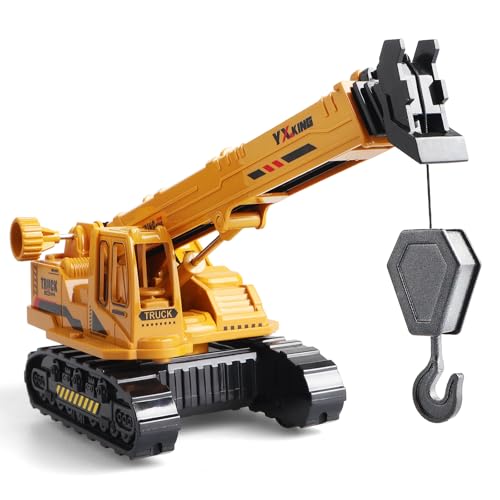
- Inertial Wheel Design: Designed with a smooth inertial wheel system, this crane toy moves forward easily with a simple push. No batteries required, allowing kids to enjoy realistic construction play anytime anywhere.
- Easy Operation: Features an adjustable boom, rotating upper cab, and extendable lifting rope, enabling children to simulate real construction site operations and enjoy hands-on role play.
- Sturdy Alloy Hook: Built with a solid metal alloy hook and high-quality ABS plastic body, this construction crane toy is sturdy, durable, and designed to withstand active play by kids.
- Educational & Fun: Encourages imaginative play while helping develop hand-eye coordination, fine motor skills, and basic engineering concepts—perfect for learning through play.
- Perfect Gift for Kids: An ideal gift choice for birthdays, Christmas, holidays, or everyday surprises. A great construction toy for boys and girls who love trucks, vehicles, and building adventures.
This product presentation was made with AAWP plugin.