NHTSA ID Number: 10165645
Manufacturer Communication Number: SMB187
Summary
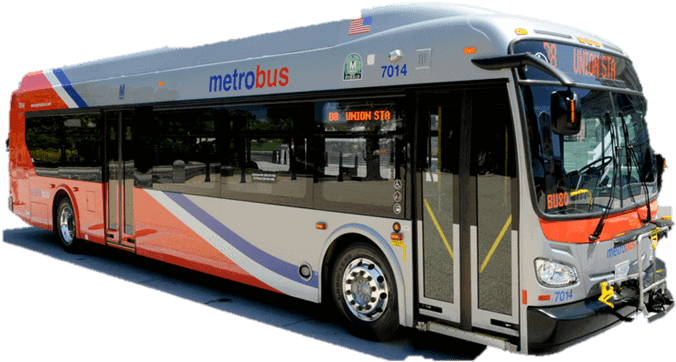
Service Manual Bulletin which stresses the need for safety when performing maintenance on the high voltage systems on your New Flyer vehicle.
64 Affected Products
Vehicles
| NEW FLYER | XDE35 | 2010-2020 |
| NEW FLYER | XDE40 | 2009-2020 |
| NEW FLYER | XDE60 | 2013-2020 |
| NEW FLYER | XE35 | 2019-2020 |
| NEW FLYER | XE40 | 2013-2020 |
| NEW FLYER | XE60 | 2017-2020 |
| NEW FLYER | XHE40 | 2018-2020 |
| NEW FLYER | XHE60 | 2015, 2020 |
| NEW FLYER | XT40 | 2014-2020 |
| NEW FLYER | XT60 | 2014-2020 |
SMB-187
ISSUE DATE: Sep 13 2019
High Voltage Safety
4 – ELECTRIC DRIVE SYSTEM
This bulletin stresses the need for safety when performing maintenance on the High Voltage System on your New Flyer vehicle.
This information supersedes any prior information on this subject already provided in your New Flyer Service Manuals. Make this Service Bulletin available to service personnel to inform them of changed information.
SEOCONTENT-START
SMB-187 1 of 6
SERVICE MANUAL BULLETIN
This Service Manual Bulletin is prepared by the Publications Department of New Flyer Industries
Canada ULC. Refer to details below.
The New Flyer vehicles described in this manual may be protected by one or more
patents and design applications or registrations in the United States and Canada,
and in other countries. Refer to “Vehicle Patent Information” in this manual.
Copyright © 2019 New Flyer Industries Canada ULC
ISSUE DATE: Sep 13 2019
SMB-187
APPLICABILITY
VEHICLE LENGTH 30ft. 35ft. 40ft. 60ft. ALL
VEHICLE TYPE
Xcelsior® MiDi® Invero®
ALL
Low Floor High Floor
FUEL TYPE
Diesel Diesel/Electric CNG LNG
ALL
Fuel Cell Trolley/Electric Battery/Electric
SUBJECT High Voltage Safety
SECTION TITLE 4 – ELECTRIC DRIVE SYSTEM
DETAILS This bulletin stresses the need for safety when performing maintenance
on the High Voltage System on your New Flyer vehicle.
This information supersedes any prior information on this subject
already provided in your New Flyer Service Manuals. Make this Service
Bulletin available to service personnel to inform them of changed information.
2 of 6 SMB-187
SERVICE MANUAL BULLETIN
SMB-187
The New Flyer vehicles described in this manual may be protected by one or more
patents and design applications or registrations in the United States and Canada,
and in other countries. Refer to “Vehicle Patent Information” in this manual.
Copyright © 2019 New Flyer Industries Canada ULC
1. SAFETY
During component removal or installation,
ensure that the vehicle is deengerized.
Set the Master Run switch to
the STOP-SYSTEM position and the
Batter Disconnect switch to the OFF
position. On vehicles equipped with a
High Voltage Interlock switch, ensure it
is in the High Voltage (HV) OFF position.
Lock and tag the switch and retain
the key. Failure to follow this procedure
may result in personal injury or component
damage.
1.1. High Voltage Safety
The Electric Drive System uses hazardous
High Voltage (HV) electrical energy.
There is a risk of electric shock. Only
trained service personnel should
access components of the High Voltage
Equipment. Failure to observe all HV
electrical safety precautions may result
in personal injury and/or death.
The highest concerns are for the safety
of service personnel working on the
vehicle and others in the vicinity, and in
minimizing the potential for damage to
property.
Death, serious injury, and significant
material damage will result if these
safety rules are not followed.
1.2. General Safety Guidelines &
Practices
The following provides general guidelines
in relation to safety and best practices
when completing installation or servicing
work on any New Flyer Electric Drive System
vehicle.
1.2.1. Definitions
1.2.1.1. High Voltage (HV)
Any form of voltage that is greater than 50
volts.
1.2.1.2. Stored Energy
Potential energy stored in electrochemical
or electrostatic devices such as batteries
or capacitors.
Personnel must always remember the
characteristics of these stored energy
devices and under what conditions they
retain energy and pose an electrocution
risk.
1.3. Equipment Requirements
The following equipment is required:
❒ Personal Protection Equipment (PPE)
meeting Category 2 ratings for Arc Flash
protection. Refer to 1.5. “PPE Requirements”
on page 3 in this bulletin for more
information on the category ratings
❒ Rubber Insulating Gloves meeting Class 0
ratings (0 to 1000 VAC/1500 VDC) for High
Voltage protection
❒ Insulated rescue hook
❒ ABC fire extinguisher, 5 lb. minimum, at the
activity areas
❒ Digital Multimeter (DMM), 1000 volt Category
III, 600 volt Category IV, 10 Megohm
impedance or greater with insulated case
or rubber holster
❒ Clamp-on current probe, 1000 volt Category
III, 600 volt Category IV
❒ High-Potential (Hi-Pot) dielectric strength
tester
❒ Phase rotation meter
❒ Adequate lighting
❒ HV insulated mat
❒ Safety barricade with warning lights and
“Danger High Voltage” signs
❒ Belt tool pouch (use only to carry small
components up/down a ladder)
❒ Torque screwdriver set
❒ Spare HV and low voltage fuses
❒ Any other equipment required by applicable
local and federal regulations
SMB-187 3 of 6
SERVICE MANUAL BULLETIN
SMB-187
The New Flyer vehicles described in this manual may be protected by one or more
patents and design applications or registrations in the United States and Canada,
and in other countries. Refer to “Vehicle Patent Information” in this manual.
Copyright © 2019 New Flyer Industries Canada ULC
1.3.1. Equipment Calibration
All test equipment must be within their calibration
interval and recorded with the
respective serial numbers. These records
must be available to the Checker.
1.3.2. Insulated Tools
Insulated tools should be visually
inspected for insulation damage before
and after each session of use.
1.4. Personnel Requirements
1.4.1. General
Only trained personnel shall supervise and
perform High Voltage system testing, servicing
and troubleshooting. Two personnel
(one called the Checker and the other
called Monitor/Recorder) shall perform
troubleshooting and servicing procedures,
together, to ensure safety of themselves,
others nearby and for the protection of
vehicle and property. Refresher training
shall be provided to these personnel as
required
1.4.2. Training Requirements
The training of personnel shall consist of:
❒ HV and low voltage basics, intermediate
and advanced electricity
❒ HV and low voltage electrical systems of
the vehicle
❒ Shop safety practices and procedures
❒ First aid including CPR and the use of the
shop defibrillator
❒ How to release a victim that can’t let go of
HV
❒ Quickest method of shutting down HV
❒ Fire fighting and emergency procedures
❒ HV and arcflash safety
❒ Organized and tidy placement of equipment
and tools allowing for unrestricted
movement
❒ Operation of High Potential (Hi-Pot) or
dielectric strength test equipment
❒ Operation of phase rotation meter
To ensure effectiveness of training, exams
of the trained material shall be required
with a high passing mark of at least 80%
and a retraining of the missed 20% on a
one to one basis.
1.5. PPE Requirements
1.5.1. General
PPE voltage class, Arc Flash rating shall
be compatible with the voltage and arc
flash capability of the systems being
tested.
1.5.1.1. Gloves
Gloves used for High Voltage protection
are divided into 6 classes by maximum
voltage rating. Class 0 (0 to 1000 VAC/
1500 VDC) rated gloves are adequate for
all New Flyer High Voltage applications.
☞NOTE:
Leather protector gloves should always be
worn over rubber insulating gloves.
1.5.1.2. Arc Flash
PPE used in high voltage applications is
divided into 5 categories by Minimum Arc
ratings. Category 2 rated PPE is adequate
for all New Flyer High Voltage applications.
See “Fig. 1: PPE Categories” on page 4.
1.5.2. PPE Care & Testing
Rubber insulated PPE shall be periodically
cleaned and tested in accordance with 29
CFR 1910.137 and the appropriate ANSI/
ASTM standards. HV gloves, sleeves and
mats shall be tested every 6 months. PPE
apparel shall be cleaned and maintained in
accordance with the manufacturer’s
instructions. A record of the PPE testing
shall be maintained and available to the
users.
4 of 6 SMB-187
SERVICE MANUAL BULLETIN
SMB-187
The New Flyer vehicles described in this manual may be protected by one or more
patents and design applications or registrations in the United States and Canada,
and in other countries. Refer to “Vehicle Patent Information” in this manual.
Copyright © 2019 New Flyer Industries Canada ULC
Fig. 1: PPE Categories
1.5.3. PPE Inspection
Inspect PPE equipment, before use, for
any degradation or damage and ensure
that the HV gloves have been tested every
6 months. Also perform an air pressure
test on the HV gloves before and after
each use. If, during PPE use, a potential
damaging incident occurred to the PPE,
stop further testing and inspect the PPE. If
at any time the PPE is defective, reject it,
and obtain an accepted one.
1.5.4. PPE Storage
PPE apparel should be stored lying flat,
undistorted, right-side out and not folded in
protective containers. The HV mats can be
rolled with an inside diameter greater than
2 inches. Rubber HV gloves should be
stored in cool, dark, dry, and free from
damaging chemicals or vapors. The glove
cuffs should face downwards, without folding,
in the appropriate glove bag and hung
vertically.
1.5.5. Electrical Injuries
Electrical injuries should be immediately
reported to first aid personnel and the
supervisor. Even non-injurious electrical
shocks, originating from components in the
HV system, should be reported to the
supervisor. All incidents should be immediately
investigated and documented to
determine the cause and prevent the
occurrence in the future.
s142301c.svg
SMB-187 5 of 6
SERVICE MANUAL BULLETIN
SMB-187
The New Flyer vehicles described in this manual may be protected by one or more
patents and design applications or registrations in the United States and Canada,
and in other countries. Refer to “Vehicle Patent Information” in this manual.
Copyright © 2019 New Flyer Industries Canada ULC
1.6. Service Preparation
❒ The scope of the work must be accurately
defined such as a Servicing Procedure
that requires systematic steps with signoffs.
Before servicing is performed, the
Supervisor, Checker and Monitor/Recorder
must conduct a briefing of what shall transpire,
identify potential hazards and resist
pressures to speed through a procedure,
anticipate problems and question possible
events. If an unexpected electrical hazard
or fault occurs, during any service work, it
must be immediately reported to the
supervisor. After the work is completed the
same group should review the results and
processes and make proposed modifications
to the procedures if required.
❒ Install Safety barricade with warning lights
and signs indicating “Danger High Voltage”
around the vehicle perimeter and ensure
no personnel are within the fenced perimeter
during the service procedure.
❒ It shall always be the goal to check the
systems as much as possible with all HV
power OFF and Locked Out/Tagged Out
and proven as de-energized by voltage
measurement using a Category III or better
Digital Multimeter (DMM). The functionality
of the DMM must be proved before
and after the verification of no HV present.
Then, if possible, the HV systems should
be challenged by trying to energize them
while checking that no HV appears.
❒ When it is necessary to perform tests of
HV systems with the power ON, then the
Working Live procedure must be followed.
Refer to 1.6.3. “Working Live” on page 6 in
this bulletin for procedure.
❒ The test personnel shall always rehearse
the actions required in case of any possible
accident scenarios.
❒ Before beginning the Service procedure,
the test personnel shall remove all their
jewelry (including pierced ones), watches
and any electrically conductive objects on
them.
PPE CATEGORIES
CATEGORY 0 CATEGORY 1 CATEGORY 2
1.2 cal/cm2 4 cal/cm2 8 cal/cm2
Arc Rated Clothing:
Untreated cotton long sleeve
shirt and pants
AR long sleeve shirt and pants
or AR coverall
AR long sleeve shirt and pants
or AR coverall
AR flash suit hood or AR face
shield
AR flash suit hood or AR face
shield and AR balaclava
AR jacket, parka, rainwear or
hard hat liner (as needed)
AR jacket, parka, rainwear or
hard hat liner (as needed)
Other Equipment:
Hard hat Hard hat Hard hat
Safety glasses Safety glasses or goggles Safety glasses or goggles
Hearing protection Hearing protection (with inserts) Hearing protection (with inserts)
Heavy duty leather gloves Heavy duty leather gloves
Leather footwear (as needed) Leather footwear (as needed)
High Voltage Gloves rated Class
0 (0 to 1000 VAC/1500 VDC)
High Voltage Gloves rated Class
0 (0 to 1000 VAC/1500 VDC)
High Voltage Gloves rated Class
0 (0 to 1000 VAC/1500 VDC)
6 of 6 SMB-187
SERVICE MANUAL BULLETIN
SMB-187
The New Flyer vehicles described in this manual may be protected by one or more
patents and design applications or registrations in the United States and Canada,
and in other countries. Refer to “Vehicle Patent Information” in this manual.
Copyright © 2019 New Flyer Industries Canada ULC
1.6.1. Vehicle Inspection
Prior to conducting any high voltage servicing,
the vehicle must be visually
inspected to ensure all systems are properly
maintained, paying special attention to
any evidence of fretting, chafing, or other
damage to HV cables or equipment.
1.6.2. Lockout/Tagout Procedure
The Lockout/Tagout procedure should be
followed as specified in the respective service
procedure.
When removing the lock and tag:
1. The locks and tags shall be removed by
the installer of the locks and tags or shall
be removed under her/his supervision.
2. If the installer of the locks and tags is not
available, then her/his supervisor:
a. Ensures that the installer of the locks
and tags is not in the facility.
b. Contacts the installer to inform her/him
that the locks and tags will be removed.
c. Reminds the installer of the lock and
tag removal when she/he resumes
work.
1.6.3. Working Live
To maximize safety, it is always important
to perform the maximum amount of HV
service in the de-energized state. Component
removal and installation must always
be performed in a de-energized state.
When it is necessary to test HV equipment
while energized or to verify whether HV is
present, the utmost care and safety procedures
must be used including:
❒ Wearing appropriate PPE including protector
gloves over top of the HV rubber
gloves.
❒ Ensuring all personnel, other than the
Checker and Monitor/Recorder, are clear
of the vehicle.
❒ Standing on HV insulated mat.
❒ Covering any energized HV components
not being immediately worked on with an
HV insulated mat to limit exposure to live
parts.
SMB187
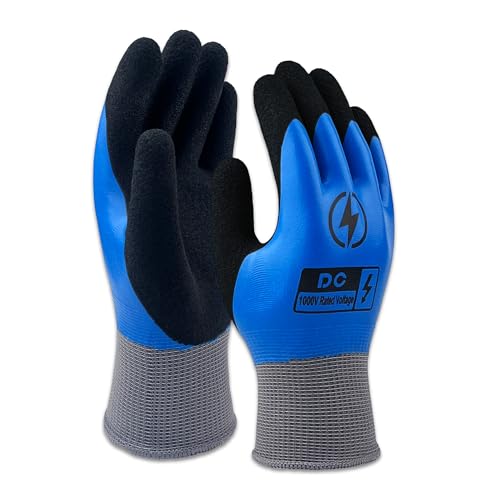
- Insulation Performance: These work gloves have insulated palms and fingers and are designed for Non-Live Electrical household electrical tasks. Before each use, carefully inspect the gloves for any damage, cracks, punctures, moisture, or contamination, and do not use them if any defect is found.
- Rubber Palm: The gloves have rubber palms that offer strong insulating and flame-retardant properties, providing safety and reliability during use.
- Anti-Slip Grip: The textured palms ensure a firm grip with anti-slip design, helping you handle tasks with confidence and prevent mistakes.
- Durable Nylon Fabric: Made from nylon fabric, the electrician's gloves are tough, resistant to wear and aging, and have a long-lasting lifespan.
- Versatile Use: These gloves are suitable for home and low-risk electrical maintenance tasks, such as handling instruments, appliances, mechanical equipment, automotive work, and other installation or maintenance projects. For electrical work where abrasion, cutting, puncture, or mechanical damage may occur, use appropriate leather protector gloves over the insulating gloves and follow applicable electrical safety practices.

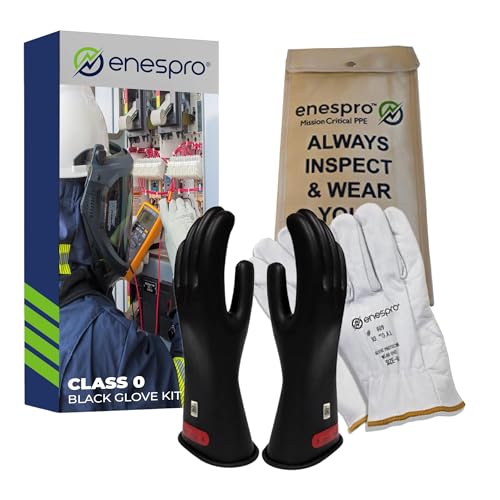
- Insulated High Voltage Gloves Kit: Protect against electrical shock on energized equipment with these electrical safety gloves; this electrical PPE kit includes a pair of 11” insulated gloves, 10” leather protectors, and a storage bag
- Complete Protection: Our black rubber electrical gloves are used with leather protectors for durability and enhanced comfort; these high voltage gloves are ideal for power generation crews and utility workers
- Enhanced Protection: Rated for 1,000 V AC / 1,500 V DC and compliant with NFPA 70E-2015; inspect these electric gloves before each use for cracks, tears, or damage, and replace if compromised to ensure safe protection
- Easy Care: To maintain longevity, wash these class 0 electrical gloves in warm water with mild soap and do not expose them to direct sunlight; store these size 9 rubber insulated gloves in a protective bag when not in use to prevent damage
- Select Size & Color: Measure the circumference of your palm to determine your electric work gloves size; these insulated electrician gloves come in sizes 8 to 12 and are offered in red, black, and yellow for easy identification and all-day wear
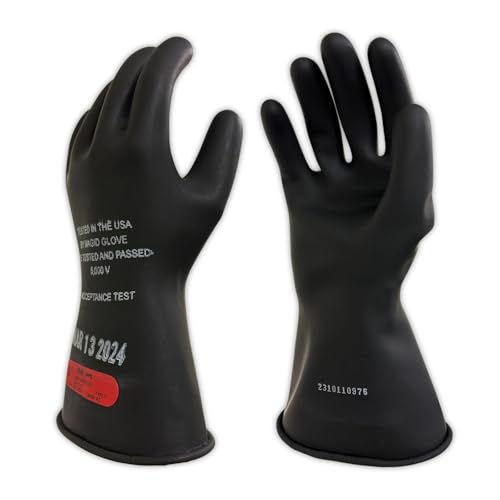
- Professional Electrical Safety: Rubber insulating gloves engineered for lineman work, electrical contractors, utility workers, and high-voltage machine operations; Essential PPE for electrical hazard protection
- Class 0 Voltage Protection: Rated for applications up to 1,000 Volts AC / 1,500 Volts DC; Provides critical electrical insulation barrier; Must be worn with leather protector gloves (sold separately) for maximum safety and durability
- Premium Natural Rubber Latex: Black dielectric rubber construction provides superior elasticity, flexibility, and puncture resistance compared to nitrile, chloroprene, or vinyl; Non-conductive material ensures reliable electrical insulation
- Extended 11-Inch Length: Provides protection beyond the wrist and over the forearm; Straight cuff with rolled edge design ensures secure fit and easy donning/doffing; Contoured shape reduces hand fatigue during extended wear
- ASTM & OSHA Compliant: Manufactured to meet ASTM D120-09, OSHA 29C FR 1910.269, and NFPA 70E standards; Requires electrical testing and recertification every 6 months per OSHA regulations; Flush rear label won't interfere with protector gloves
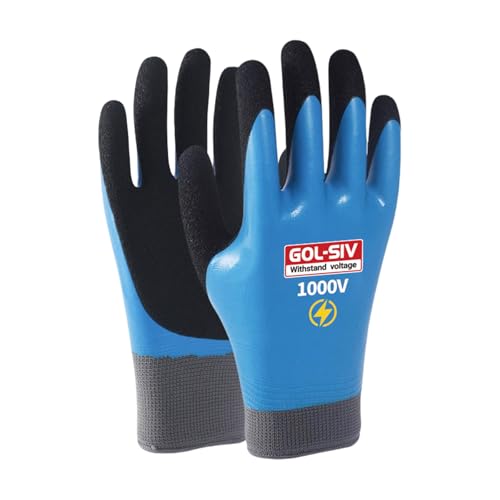
- Insulation Performance: These electrician gloves feature insulated palms and fingers and comply with ASTM D120 standard, providing effective electrical safety gloves protection when operating electrical equipment at 1000V and below
- Rubberized Palm & Fingers: The slip-resistant electrical insulated gloves are made of rubber with excellent insulating and flame retardant properties, ensuring safety and reliability during operation for electrician tasks
- Rubberized Non-Slip Design: The textured palm of these nylon electrician gloves increases friction through an anti-slip design, giving you a better grip on tools with reliable high voltage gloves performance
- Durable Flexible Nylon: These electrical safety gloves are made of wear-resistant, breathable nylon fabric that is strong, durable, flexible to wear, breathable and comfortable, with a long service life
- Multi-Scene Application: These electrical insulated gloves are suitable for home repair and professional electrician work, such as automotive repair, electrical maintenance, and equipment installation

- 🧰[Ultimate Safety Design]:Thickness 1.8mm to avoid the risk of scratching, puncturing, etc., to ensure absolute safety.Abandoned part of the flexibility to pursue the ultimate in security and protection. Rubber material is very soft and smoothand the rolled cuff is easy to take off.
- 🧰[High - Quality Material]: Insulated gloves are made of the finest dielectric natural rubber, with excellent resilience, insulation, waterproof, high-pressure resistance, abrasion resistance, more comfortable and durable to wear, ensuring your safety at work.
- 🧰[High-Voltage Operation]: Check voltage12000V. Safety gloves are used as basic security appliances under 3000V, and as auxiliary security appliances 3000V-8000V. Effectively protect your safety and keep you away from danger.
- 🧰[Wide Range Of Applications]:Safety work gloves are suitable for lineman work, electrical contractor and field service work, high-voltage machine operations, and other industrial applications.
- 🧰[Lineworker Professional Gloves]: Length 15.8 inches, width 7.5 inches (Cuff), fitting for most hand sizes. This electrical tools are perfectly suitable for your life, work, operation and arm protection.
This product presentation was made with AAWP plugin.